




At Lasso, we believe it’s time to reclaim what “normal” really means.
Many women are told that period pain is just the price of having a cycle.
But when pain steals workdays, sleep, or your ability to function, that’s not “just how it is.” It’s your body asking for attention.
Your Cycle Has a Rhythm
A woman’s body moves through four phases each month: menstruation, follicular, ovulation, and luteal. These inner seasons are shaped by key hormones like estrogen, progesterone, FSH, and LH.
When hormones are working in sync, your cycle feels like a rhythm: steady, cyclical, and wise.
When they’re out of balance, that rhythm can unravel, showing up in your bleeding, mood, energy, and pain.
PMS: What Happens Before Your Period
Premenstrual syndrome (PMS) occurs in the luteal phase, the days after ovulation and before bleeding begins.
- Common PMS symptoms include:
- Mood changes (irritability, increased emotional sensitivity)
- Bloating and breast tenderness
- Fatigue and sleep changes
- Food cravings or appetite shifts
PMS is defined by both its timing and its wide-ranging effects: symptoms appear before your period and typically improve once bleeding starts.
There is also a more severe form called PMDD (premenstrual dysphoric disorder), where mood symptoms are intense and disruptive. If you experience severe depression, rage, or thoughts of self‑harm in the days leading up to your period, it’s important to seek professional support.
Period Pain: What Happens During the Bleed
Period pain (dysmenorrhea) is different from PMS.
It refers to cramping and pain that occur with your period, often starting just before or as bleeding begins.
What’s happening in your body:
The uterus releases prostaglandins (chemical messengers)
Prostaglandins cause the uterine muscle to contract
These contractions help shed the uterine lining—but can also cause pain
Typical period pain looks like:
Cramping in the lower abdomen or lower back
Mild to moderate pain
Symptoms that are strongest in the first 1-2 days
Improved with rest, heat, and over‑the‑counter anti‑inflammatories (when used as directed)
This kind of discomfort is common. But “common” doesn’t mean you have to accept it as normal.
What’s Considered “Normal” Pain?
Period pain may be considered within the typical range if:
It lasts for a few days around your period
It doesn’t regularly interfere with work, school, or daily activities
It improves with recommended doses of pain relievers, heat, or rest
It isn’t becoming progressively worse over time
Your lived experience matters too.
If your pain feels unmanageable, that is worth discussing with a healthcare professional.
Red Flags: When Pain Is Not “Just Cramps”
Certain patterns may suggest your pain is linked to something more than typical cramps:
Pain so intense that you often miss work, school, or social plans
Pain that gets worse month after month
Cramps that start several days before bleeding and continue long into your period
Pain during or after sex
Pain with bowel movements or urination, especially around your period
Very heavy bleeding or passing large clots
These can be signs of conditions such as endometriosis, adenomyosis, or fibroids. These are medical issues, not a sign of weakness or a low pain tolerance.
If this sounds like you, your next step is not “stronger pain meds.” It’s a deeper evaluation.
PMS vs Period Pain at a Glance
You can use this quick overview to understand where your symptoms fit.
Timing
PMS: Typically begins in the luteal phase, 1-2 weeks before your period, and improves once bleeding starts.
Period pain: Starts just before or with bleeding; worst on days 1–2 of your period.
Main symptoms
PMS: Mood changes, bloating, breast tenderness, fatigue, cravings
Period pain: Cramping low in the belly or back, sometimes nausea, loose stools, or fatigue
When to get checked
PMS: Severe mood changes, depression, or thoughts of self‑harm (think PMDD)
Period pain: Pain that is disabling, worsening, or not helped by usual treatments
Knowing this helps you track what’s happening—and ask more targeted questions at appointments.
How to Talk to a Clinician About Your Pain
You don’t need to “earn” a visit by being in unbearable pain.
If your cycle is affecting your life, that’s enough reason to seek help.
A few steps that make conversations easier:
1. Track your symptoms for 2–3 cycles
Write down:
When symptoms start (which day of your cycle)
How intense they are (0–10 scale)
What they feel like (crampy, sharp, deep, burning)
What helps and what doesn’t
2. Bring specific questions
For example:
“Could my pain be related to endometriosis, fibroids, or another condition?”
“What tests or exams make sense for me?”
“What treatment options do we have beyond over‑the‑counter pain relievers?”
3. Remember you can ask for a second opinion
If you feel brushed off, you’re allowed to look for a provider who takes your pain seriously.
Normalizing menstrual pain can delay diagnosis for years.
Gentle Ways to Support Your Body
Alongside medical care, many women find day‑to‑day practices helpful:
Heat (heating pad or warm bath) on the lower belly or back
Gentle movement or stretching to improve blood flow
Adequate sleep
Regular meals for more stable energy and blood sugar balance
Over‑the‑counter anti‑inflammatory medications (NSAIDS) used as directed, if appropriate for you and used as directed by a clinician or medical professional
These won’t fix an underlying condition, but they can support you while you seek answers.
Which Lasso Formula Fits Your Cycle?
If you’re exploring supplements as part of your plan, your choice depends on what feels hardest right now:
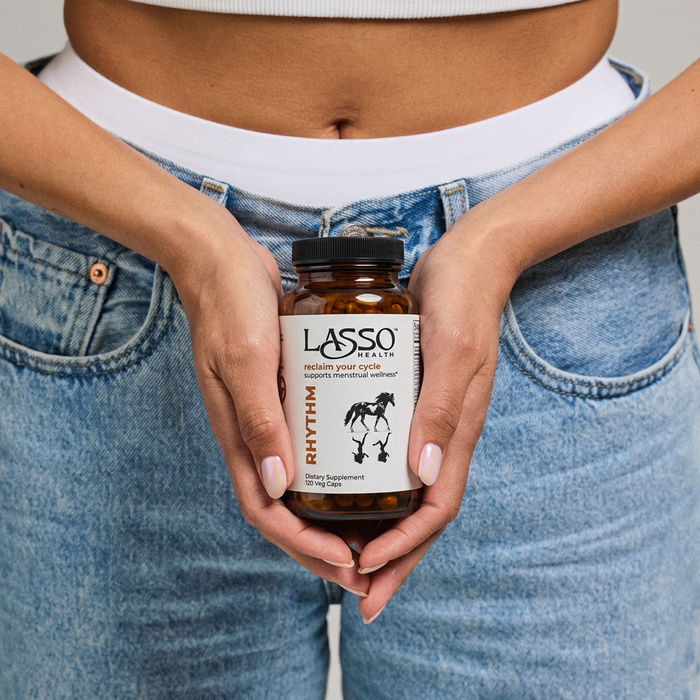
Rhythm may be a fit if your cycle feels physically intense, with heavy bleeding, painful periods, or symptoms that throw off your month. It’s formulated with NAC, DIM, and Calcium D-Glucarate as part of a broader approach to cycle support.
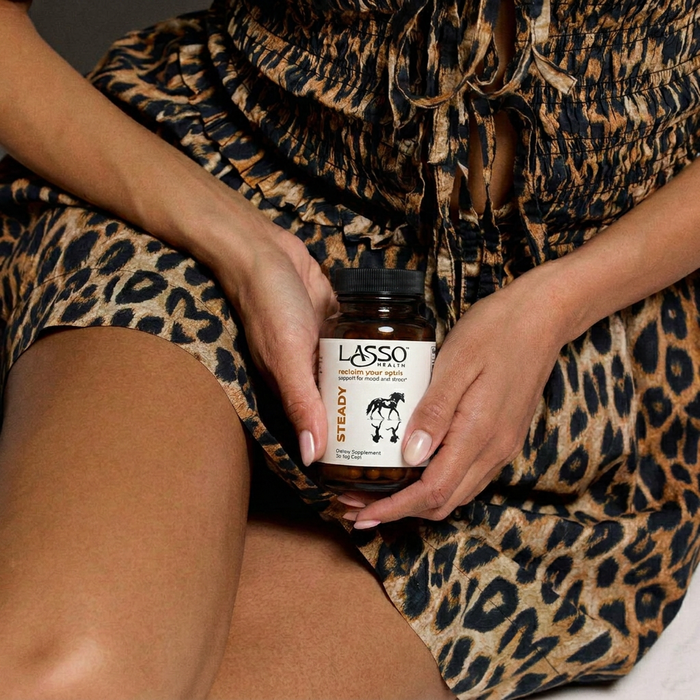
Steady may be a better fit if PMS, mood swings, and emotional strain are the hardest part of your cycle. It’s crafted to support mood, calm, and emotional well-being throughout your cycle, with Affron® Saffron and Meriva® Curcumin.
If both the physical and emotional sides feel difficult, the two formulas can be used together for broader support.
In summary, PMS and period pain are related but different parts of your cycle story, and neither should leave you suffering in silence. Your body’s rhythm is worth listening to—and you’re allowed to ask for more support when it hurts.
References
Management of Premenstrual Disorders
Yonkers KA, O’Brien PMS, Eriksson E. Management of Premenstrual Disorders. Obstet Gynecol. 2023;142(4):e1-e18. doi: 10.1097/AOG.0000000000005338. PMID: 37742373.
https://pubmed.ncbi.nlm.nih.gov/37742373/
Premenstrual Dysphoric Disorder (PMDD)
Carlini SV, Deligiannidis KM. Premenstrual Dysphoric Disorder. StatPearls [Internet]. Treasure Island (FL): StatPearls Publishing; 2025 Jan-.
https://www.ncbi.nlm.nih.gov/books/NBK532307/
Dysmenorrhea: Painful Periods
American College of Obstetricians and Gynecologists. Dysmenorrhea: Painful Periods. https://www.acog.org/womens-health/faqs/dysmenorrhea-painful-periods
Dysmenorrhea
Iacovides S, Avidon I, Baker FC. Dysmenorrhea. Nat Rev Dis Primers. 2015;1:15009. doi: 10.1038/nrdp.2015.9. PMID: 27188916.
https://pubmed.ncbi.nlm.nih.gov/27188916/
Dysmenorrhea, a Narrative Review of Therapeutic Options
Proctor M, Farquhar C. Dysmenorrhea, a Narrative Review of Therapeutic Options. PMC. 2024.
https://pmc.ncbi.nlm.nih.gov/articles/PMC11332412/
Endometriosis
Zondervan KT, Becker CM, Missmer SA. Endometriosis. N Engl J Med. 2020 Mar 26;382(13):1244-1256. doi: 10.1056/NEJMra1810764. PMID: 32212520.
https://pubmed.ncbi.nlm.nih.gov/32212520/
Endometriosis - Symptoms and causes
Mayo Clinic Staff. Endometriosis - Symptoms and causes. Mayo Clinic.
https://www.mayoclinic.org/diseases-conditions/endometriosis/symptoms-causes/syc-20354656
Uterine Fibroids - Symptoms and causes
Mayo Clinic Staff. Uterine fibroids - Symptoms and causes. Mayo Clinic.
https://www.mayoclinic.org/diseases-conditions/uterine-fibroids/symptoms-causes/syc-20354288

