






PMOS, Insulin, and Your Cycle
At Lasso Health, we see PMOS (formerly PCOS) as a rhythm issue, not a personal failure.
PMOS, Insulin, and Your Cycle: When Your Rhythm Feels Off
PMOS (formerly known as PCOS, or Polycystic Ovary Syndrome) can make your cycle feel like it’s stuck on shuffle with periods that don’t show up on time, acne that lingers, and energy that crashes without warning.
Underneath many of these symptoms are shifts in hormones, ovulation patterns, and insulin signaling.
What is PMOS (Formerly PCOS)?
PMOS (previously called PCOS) is a common hormonal and metabolic condition that affects women of reproductive age. It’s less about “cysts” and more about how hormones, metabolism, and the ovaries communicate.
PMOS Symptoms: How It Shows Up In Your Body
-
Irregular, infrequent, or absent periods
-
Extra hair growth on the face or body (hirsutism)
-
Acne or oily skin
-
Hair thinning on the scalp
-
Weight changes, often around the abdomen
-
Fertility challenges
Not everyone has all of these symptoms. Your experience with PMOS is individual—and it can evolve over time.
How PMOS Affects Your Menstrual Cycle
In a typical cycle, hormones rise and fall in a coordinated rhythm that supports ovulation. In PMOS, that rhythm is often disrupted.
Common cycle patterns include:
-
Periods more than 35 days apart
-
Fewer than 8 periods per year
-
Long gaps without bleeding followed by heavier cycles
Because ovulation is often delayed or doesn’t occur, PMOS/PCOS remains one of the leading causes of anovulation and infertility worldwide.
The Link Between PMOS and Insulin Resistance
Insulin plays a central role in PMOS (PCOS). It helps move glucose from the bloodstream into cells for energy.
In insulin resistance, cells don’t respond efficiently, so the body produces more insulin to compensate. Elevated insulin levels can:
-
Signal the ovaries to produce more androgens (like testosterone)
-
Lower SHBG, a protein that binds excess hormones
-
Disrupt signals from FSH and LH that coordinate ovulation
The downstream effect can include irregular ovulation, cycle disruption, acne, unwanted hair growth, and metabolic changes.
Why PMOS Is Often Misdiagnosed or Missed
PMOS (PCOS) is one of the most common endocrine conditions in reproductive-age women, yet many go undiagnosed for years.
This often happens because:
-
Symptoms are normalized or dismissed
-
Irregular cycles are considered typical in younger years
-
Care focuses on isolated symptoms rather than root patterns
If you’ve felt overlooked or confused, you’re not alone.
PMOS and Long-Term Health Risks
PMOS doesn’t just affect your cycle. Because of its connection to insulin resistance, it also influences long-term metabolic health.
PMOS/PCOS is associated with:
-
Increased risk of pre-diabetes and type 2 diabetes
-
Changes in cholesterol and triglycerides
-
Elevated cardiovascular risk over time
Research shows that women with PCOS have a significantly higher lifetime risk of developing type 2 diabetes compared to those without.
Understanding insulin is not about fear—it’s about having more tools to support your long-term health.
Evidence-Based Ways to Support PMOS
Care for PMOS is individualized, but evidence-based approaches often include a combination of lifestyle, medical, and supportive strategies.
Lifestyle support:
Gentle, consistent movement and blood sugar–supportive nutrition can improve insulin sensitivity and metabolic stability over time.
Hormonal options:
Birth control pills, hormonal IUDs, and other therapies may help regulate bleeding, reduce androgen levels, and improve skin symptoms for those not trying to conceive.
Metabolic medications:
Metformin and similar therapies can support insulin sensitivity and may help restore more regular cycles in some individuals.
Fertility-focused care:
For those trying to conceive, ovulation induction (such as letrozole or clomiphene) or other fertility treatments may be recommended.
Your care plan should reflect your priorities—whether that’s cycle regularity, symptom relief, fertility, or long-term health.
How to Talk to Your Doctor About PMOS (PCOS)
You deserve clear answers and a care plan that aligns with your goals.
Consider asking:
-
“Could PMOS (PCOS) be contributing to my symptoms?”
-
“Can we evaluate my blood sugar and hormone markers?”
-
“What are my options if I’m not trying to conceive?”
-
“How will we measure progress over time?”
Tracking your symptoms and questions ahead of appointments can make care feel more collaborative and less overwhelming.
Supplements for PMOS: Finding the Right Support
If you’re exploring supplements as part of your PMOS toolkit, start by asking: what feels most out of balance—your body or your mood?
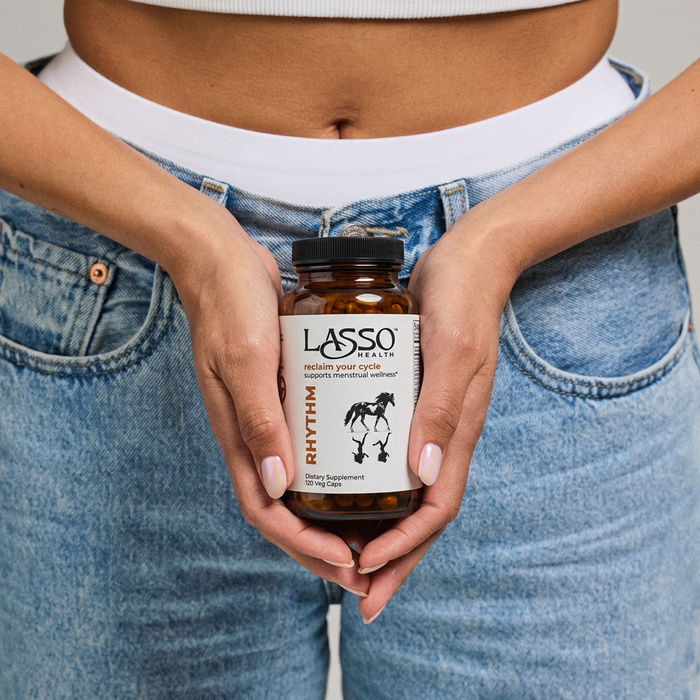
Start with Rhythm if PMOS shows up primarily in your body: irregular or heavy cycles, physical PMS symptoms, breast tenderness, or signs of estrogen imbalance. Rhythm is designed as a daily foundation for hormone support and cycle regulation, with NAC, DIM, and Calcium D-Glucarate to support estrogen metabolism and gentle hormone clearance, alongside antioxidant and metabolic support.
Choose Steady if the emotional weight feels heavier: stress, mood swings, anxiety, or feeling on edge throughout your cycle. Steady is formulated to support mood, stress response, and nervous system resilience with ingredients like Affron® Saffron and Meriva® Curcumin.
If your experience feels like both, you can combine Rhythm + Steady for layered support—Rhythm for hormonal and cycle patterns, Steady for emotional balance and stress support.
As always, supplements should complement—not replace—care from your clinician.
PMOS FAQs:
PMOS vs PCOS: What’s the Difference?
Answer: PMOS is an updated term that reflects the metabolic and hormonal nature of the condition, while PCOS remains the widely recognized medical diagnosis.
Can insulin resistance cause PCOS symptoms?
Answer: Yes. Elevated insulin can increase androgen production, disrupt ovulation, and contribute to symptoms like acne, irregular cycles, and weight changes.
Is PMOS the same as PCOS?
Answer: PMOS refers to the same underlying condition as PCOS but emphasizes its metabolic and systemic nature rather than focusing on ovarian cysts.
Science & References
Insulin Resistance and fertility in polycystic ovary syndrome:
Fica S, Albu A, Constantin M, Dobri GA. Insulin resistance and fertility in polycystic ovary syndrome. J Med Life. 2008 Oct-Dec;1(4):415-22. https://pmc.ncbi.nlm.nih.gov/articles/PMC3018970/
Evidence-based Guideline for the Assessment and Management of Polycystic Ovary Syndrome.
Teede HJ, Tay CT, Laven JJE, Dokras A, Moran LJ, Piltonen TT, Costello MF, Boivin J, Redman LM, Boyle JA, Norman RJ, Mousa A, Joham AE. Recommendations From the 2023 International Evidence-based Guideline for the Assessment and Management of Polycystic Ovary Syndrome. J Clin Endocrinol Metab. 2023 Sep 18;108(10):2447-2469. doi: 10.1210/clinem/dgad463. PMID: 37580314; PMCID: PMC10505534.
https://pubmed.ncbi.nlm.nih.gov/37580314/
Insulin resistance in polycystic ovary syndrome phenotypes and the vicious cycle model in its etiology.
Szkodziak P, Szkodziak F, Trzeciak K, Woźniak S, Młynarczyk M, Paszkowski T. Insulin resistance in polycystic ovary syndrome phenotypes and the vicious cycle model in its etiology. Sci Rep. 2025 Nov 27;15:42649.
https://www.nature.com/articles/s41598-025-26718-2
Polycystic Ovarian Syndrome
Shukla A, Rasquin LI, Anastasopoulou C. Polycystic Ovarian Syndrome. [Updated 2025 Jul 7]. In: StatPearls [Internet]. Treasure Island (FL): StatPearls Publishing; 2026 Jan-. Available from: https://www.ncbi.nlm.nih.gov/books/NBK459251/
WHO PCOS fact sheet — broad, high-level support for symptoms, prevalence, anovulation, and metabolic risk.
https://www.who.int/news-room/fact-sheets/detail/polycystic-ovary-syndrome
Johns Hopkins PCOS overview — supports the symptom list in plain language.
https://www.hopkinsmedicine.org/health/conditions-and-diseases/polycystic-ovary-syndrome-pcos
Hormonal Changes in PCOS
Yang J, Chen C. Hormonal changes in PCOS. J Endocrinol. 2024 Feb 15;261(1):e230342. doi: 10.1530/JOE-23-0342. PMID: 38285626.
https://pubmed.ncbi.nlm.nih.gov/38285626/
Insulin resistance and the polycystic ovary syndrome: mechanism and implications for pathogenesis
Dunaif A. Insulin resistance and the polycystic ovary syndrome: mechanism and implications for pathogenesis. Endocr Rev. 1997 Dec;18(6):774-800. doi: 10.1210/edrv.18.6.0318. PMID: 9408743.
https://pubmed.ncbi.nlm.nih.gov/9408743/
Metabolic Syndrome and PCOS: Pathogenesis and the Role of Metabolites
Chen W, Pang Y. Metabolic Syndrome and PCOS: Pathogenesis and the Role of Metabolites. Metabolites. 2021 Dec 14;11(12):869. doi: 10.3390/metabo11120869. PMID: 34940628; PMCID: PMC8709086.
https://pmc.ncbi.nlm.nih.gov/articles/PMC8709086/

